Vincent G. Kling
Vincent George Kling (1916–2013) was among the most consequential American architects of the postwar generation and remains one of the most underrecognized. Born in East Orange, New Jersey, the son of a builder, he earned a Bachelor of Architecture from Columbia University in 1940 and a Master of Architecture from MIT in 1941. After serving as a naval aviator in the Atlantic fleet during World War II, he worked briefly at Skidmore, Owings and Merrill in New York — an experience that shaped his understanding of how large architectural practices could be organized — before founding his own firm in Philadelphia in 1946.[1]
The office he built grew steadily and deliberately. By the early 1970s, the Kling organization had become the largest architectural practice in Pennsylvania, with nearly four hundred employees organized into specialist studios for architecture, engineering, interior design, and landscape.[2]
Among the most prominent of his completed works are the Municipal Services Building in Philadelphia (1965), the Hartford Civic Center (1975), the Richmond Coliseum (1971), and the American Cyanamid world headquarters in Wayne, New Jersey.[3]
He received the Philadelphia Award in 1970 and was elevated to Fellowship in the American Institute of Architects. He died in 2013 at the age of ninety-six.[4]
Kling’s Design for the GEICO Headquarters
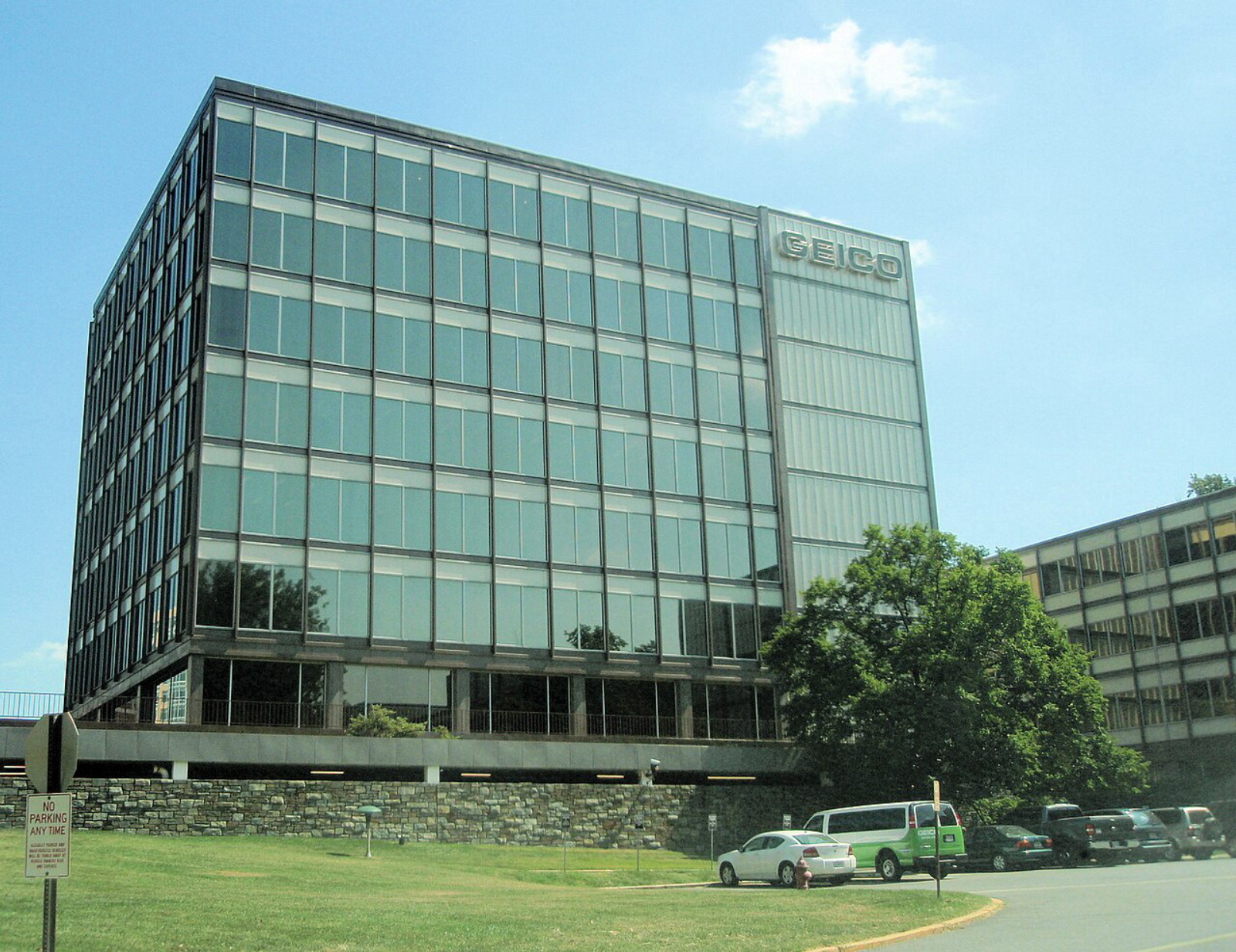
Kling was commissioned to design a purpose-built headquarters campus for the Government Employees Insurance Company in the late 1950s, and the result — completed in 1959 on a twenty-six-acre site at 5260 Western Avenue in Chevy Chase, Maryland — stands as one of his most accomplished works in the corporate mode.[5]
The campus belongs to a specific and significant chapter in the history of American corporate architecture: the landscaped suburban headquarters complex, which emerged in the postwar period as an alternative to the urban office tower. Eero Saarinen’s General Motors Technical Center in Warren, Michigan (1956)[6] and Skidmore, Owings and Merrill’s Connecticut General Life Insurance headquarters in Bloomfield, Connecticut (also mid-1950s)[7] had helped establish the type’s canonical parameters.
Kling’s contribution to this lineage at Chevy Chase is a composition of carefully articulated masses set within an open landscape: long, low horizontal wings are contrasted by taller opaque blocks sheathed in textured porcelain enamel panels and colored, crystal-textured glass panels. The whole is threaded through with mature trees, terraced parking, and signature flying-saucer light fixtures. A broad fountain at the entrance reads almost as a landing pad, reinforcing the campus’s sense of arrival.[8] A vertical office tower was added to the complex in 1964, introducing a compositional accent that restructured the ensemble’s hierarchy without disrupting its essential character.[9] The building has been recognized by Montgomery Modern, the regional mid-century modernist preservation initiative, as a significant work deserving documentation and consideration.[10]
History and Use of the GEICO Headquarters
The Government Employees Insurance Company had been founded in 1936 by Leo Goodwin Sr. and his wife Lillian in San Antonio, Texas, and relocated to the Washington metropolitan area in 1937 in order to position the firm near the largest concentration of federal civilian employees, its original and defining target market.[11] By the late 1950s GEICO was expanding rapidly under the leadership of Lorimer Davidson, who became chairman and chief executive officer in 1958.[12]
Davidson presided over the opening of the Kling-designed campus in 1959.[13] Known formally as One GEICO Plaza,[14] the complex served as the company’s world headquarters without interruption for the entirety of its subsequent history. GEICO grew to become one of the largest auto insurers in the United States during the decades it occupied the campus, and the buildings grew with it, eventually reaching a total built area of approximately 514,000 square feet[15] — a tenure ultimately spanning sixty-five to sixty-six years.
The Current Situation
In February 2025, GEICO announced that it was vacating the Chevy Chase campus, citing the buildings as no longer suited to the company’s operational needs, and relocating its headquarters to 7272 Wisconsin Avenue in downtown Bethesda.[16] The departure effectively ended the campus’s sixty-six-year function as a working headquarters and left the entire complex vacant.
By October 2025, plans for the site’s redevelopment had begun to take shape, with office uses removed from the program and residential density added.[17] In February 2026, GEICO selected a development team — EYA and Bernstein Management Corporation — to redevelop the campus.[18] The announced program calls for approximately 520 new residential units.[19] Demolition of the existing structures is anticipated as part of the redevelopment; no adaptive reuse of Kling’s buildings has been proposed.
The GEICO headquarters has not been listed on the National Register of Historic Places and does not appear to have been formally evaluated by the Maryland Historical Trust in connection with the current redevelopment proposal. No preservation organization has publicly intervened. The timeline toward demolition is active, and the window for documentation and advocacy is closing. The loss of the campus would remove one of the most substantial surviving examples of postwar American corporate campus architecture in the mid-Atlantic region, and one of the significant works of a major architect whose broader legacy remains insufficiently recognized.
Notes
[1] "Vincent Kling, 96, Led Architecture Firm," Philadelphia Inquirer, January 6, 2014; "Vincent G. Kling," AIA Historical Directory of American Architects, aia.org.
[2] Philadelphia Inquirer, January 6, 2014; Hidden City Philadelphia, hiddencityphila.org.
[3] Philadelphia Inquirer, January 6, 2014; see also "Municipal Services Building," Philadelphia Historical Commission, phila.gov; "Hartford Civic Center," Connecticut Landmarks, ctlandmarks.org.
[4] Philadelphia Award, "Award Recipients," philaaward.org; Philadelphia Inquirer, January 6, 2014.
[5] "One GEICO Plaza," Montgomery Modern Documentation Project, montgomerymodern.org.
[6] Pier Luigi Serraino, Eero Saarinen (Taschen, 2005).
[7] Nicholas Adams, Skidmore, Owings & Merrill: The Experiment Since 1936 (Phaidon, 2006).
[8] "One GEICO Plaza," Montgomery Modern Documentation Project, montgomerymodern.org.
[9] "GEICO to Move Headquarters to Downtown Bethesda," Bethesda Today, February 27, 2025, bethesdamagazine.com; "One GEICO Plaza," Montgomery Modern Documentation Project, montgomerymodern.org.
[10] "One GEICO Plaza," Montgomery Modern Documentation Project, montgomerymodern.org.
[11] "Government Employees Insurance Company," Wikipedia, en.wikipedia.org/wiki/Government_Employees_Insurance_Company.
[12] "Government Employees Insurance Company," Wikipedia, en.wikipedia.org/wiki/Government_Employees_Insurance_Company.
[13] "One GEICO Plaza," Montgomery Modern Documentation Project, montgomerymodern.org.
[14] "GEICO to Move Headquarters to Downtown Bethesda," Bethesda Today, February 27, 2025, bethesdamagazine.com; "Former GEICO Headquarters in Friendship Heights Set for Major Redevelopment," The MoCo Show, March 26, 2026, mocoshow.com.
[15] "Former GEICO Headquarters in Friendship Heights Set for Major Redevelopment," The MoCo Show, March 26, 2026, mocoshow.com.
[16] "GEICO to Move Headquarters to Downtown Bethesda," Bethesda Today, February 27, 2025, bethesdamagazine.com.
[17] "Office Space Removed from Redevelopment Plans for Geico’s Friendship Heights Campus," Bethesda Today, October 27, 2025, bethesdamagazine.com.
[18] "Bethesda’s EYA, D.C. Firm to Redevelop Geico Campus in Friendship Heights," Bethesda Today, February 18, 2026, bethesdamagazine.com; "GEICO Selects Development Team to Revamp Chevy Chase Campus," Connect CRE, February 23, 2026, connectcre.com.
[19] "EYA & Bernstein Management to Redevelop GEICO Headquarters," EYA Blog, March 25, 2026, eya.com/blog/eya-bernstein-management-to-redevelop-geico-headquarters; "The Residential Redevelopment of the GEICO Headquarters Moves Forward," UrbanTurf DC, dc.urbanturf.com/articles/blog/the_residential_redevelopment_of_the_geico_headquarters_moves_forward/24500.